AI-Trained Robot Invents Its Own Sprint at the 2026 World Humanoid Robot Games
AI-trained robot stuns crowds at the 2026 World Humanoid Robot Games by inventing its own sprint technique instead of following programmed steps.
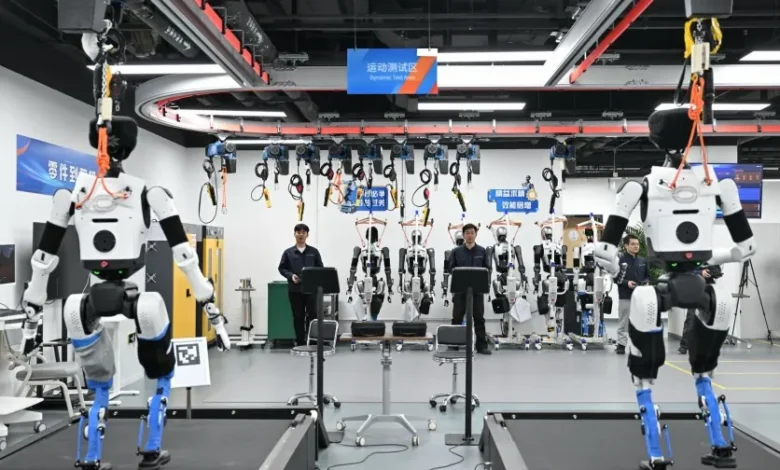
An AI-trained robot just did something no engineer told it to do. At the 2026 World Humanoid Robot Games, a humanoid machine trained through reinforcement learning didn’t just run a sprint race, it worked out its own way of running, one that its own developers hadn’t programmed or anticipated. The moment has become one of the most talked-about stories in robotics this year, and for good reason. It touches on a question that’s been building for a while now: what happens when we stop telling robots exactly how to move, and instead let them figure it out themselves?
According to a report from Tech Times, the robot’s sprinting form emerged from training rather than direct instruction. That distinction matters more than it might sound at first. Traditional robotics relies on engineers hand-coding every joint angle and movement sequence. This robot, instead, was given a goal, run fast and stay upright, and an AI system worked backward from thousands of simulated attempts to find a technique that worked. The result was a running style that looked distinct from anything human sprinters or previous robots have shown.
This article breaks down what happened at the games, why the AI-trained robot’s self-invented sprint is a meaningful development, and what it could mean for the future of humanoid robotics.
What Happened at the 2026 World Humanoid Robot Games
The World Humanoid Robot Games has quickly become one of the most closely watched events in the robotics calendar. It brings together humanoid machines from research labs, universities, and robotics companies to compete in physical events that mirror human athletic competition, sprinting, obstacle courses, and coordination-based tasks.
During the sprinting event, most competing robots ran using movement patterns that closely mimicked human biomechanics, since that’s typically what training data and simulation models are built around. But the AI-trained robot at the center of this story broke from that pattern. Instead of a human-like stride, it developed a technique that engineers and commentators described as unconventional, something that hadn’t shown up in earlier testing or previous competitions.
A few things stood out about the moment, based on the Tech Times report:
- The robot’s running gait was not manually programmed by its development team.
- The technique appeared during training, not during the live event itself.
- Observers and engineers reportedly found the movement pattern surprising, since it diverged from typical human-inspired locomotion.
- The robot completed the sprint using this self-derived method rather than reverting to a standard, pre-set walking or running gait.
For an event built around showcasing what humanoid robots can do, a machine inventing its own solution to a physical problem was exactly the kind of headline moment organizers likely hoped for.
How the AI-Trained Robot Invented Its Own Sprint
To understand why this matters, it helps to know a bit about how modern humanoid robots actually learn to move.
Reinforcement Learning and Emergent Gait
Most advanced robots today, including this one, are trained using a method called reinforcement learning. In simple terms, the robot (or more accurately, a simulated version of it) is placed in a virtual environment and given a goal, in this case, moving forward as quickly as possible without falling. The AI system then runs the simulation over and over, sometimes millions of times, adjusting the robot’s movements slightly with each attempt based on what worked and what didn’t.


Over enough iterations, the system converges on a movement pattern that maximizes speed and stability according to the rules it was given. This is what’s known as an “emergent” behavior, meaning it wasn’t explicitly coded by a human, it emerged naturally from the training process itself.
This is exactly what appears to have happened with the sprinting robot at the games. Rather than being told “bend your knee this many degrees, swing your arm like this,” the robot’s AI model was simply told to get from point A to point B as fast as possible. The specific sprint technique that resulted was the system’s own solution to that problem.
Why This Differs from Traditional Robot Programming
Older approaches to robot locomotion relied heavily on biomechanical modeling, essentially reverse-engineering how humans or animals move and then coding those patterns directly into the robot’s control system. It works, but it’s limited. The robot can only move the way its programmers understood movement to work.
AI-trained robots flip that approach. Instead of starting with a known solution, they start with a goal and let the system search for its own answer. Sometimes that answer looks similar to how humans move. Sometimes, as seen at the 2026 World Humanoid Robot Games, it doesn’t. The AI isn’t constrained by human intuition about what “good running form” should look like, it’s only constrained by physics and the objective it was given.
This is part of why researchers in the field, including those cited in coverage from outlets like IEEE Spectrum, have been paying closer attention to reinforcement learning as a training method for legged robots over the past few years. It tends to produce results that are more adaptable to real-world unpredictability than hand-coded systems, even if the resulting movement looks unusual to a human observer.
The World Humanoid Robot Games: Background and Significance
Origins of the Competition
The World Humanoid Robot Games grew out of a broader push, particularly from research institutions and robotics companies in China and elsewhere, to create standardized, public-facing benchmarks for humanoid robot performance. Rather than testing robots only in labs, the competition puts them through physical events in front of live audiences, treating robotics progress the way a track meet treats athletic progress: as something measurable, comparable, and visible.
The event has grown quickly since its earlier editions, with more teams, more event categories, and increasingly sophisticated machines each year. The 2026 games represent one of the largest and most technically advanced editions yet, according to Tech Times’ reporting.
Categories and Events
While sprinting draws a lot of attention because it’s easy to understand and dramatic to watch, the games typically include a range of physical challenges designed to test different aspects of humanoid robot capability:
- Sprint and distance running events – testing speed, balance, and stability at pace.
- Obstacle navigation – testing a robot’s ability to adapt movement in real time.
- Coordination and manipulation tasks – testing dexterity and fine motor control.
- Team-based or cooperative challenges – testing how robots interact with each other or with human operators.
Sprinting tends to be one of the clearest demonstrations of how far reinforcement learning and AI training have come, since running is deceptively hard for a bipedal machine. Balance, momentum, and joint stress all have to be managed simultaneously, and small errors compound quickly at speed. That’s part of why an AI-trained robot solving that problem on its own terms is such a notable development.
Why an AI-Trained Robot’s Self-Made Sprint Matters
Implications for Robotics Research
When a robot develops its own movement solution, it tells researchers something important: the AI model is capable of finding efficient, functional strategies that humans might not have thought to try. That’s valuable, because human intuition about movement is limited to human anatomy. A robot doesn’t have to move like a person to move well, it just has to solve the physics problem in front of it.
This has a few practical implications:
- Faster development cycles. Teams may spend less time manually tuning gait patterns and more time refining training objectives and simulation environments.
- More adaptable robots. Machines trained this way may generalize better to uneven terrain, unexpected obstacles, or degraded conditions, since their movement wasn’t built around one rigid assumption.
- New design possibilities. If AI systems keep finding non-human movement solutions, it could influence how future humanoid robots are physically built, not just how they’re programmed.
Real-World Applications Beyond the Track
It’s easy to view a robot sprinting competition as a novelty, but the underlying technology has applications well beyond athletic events. Search-and-rescue robots need to move quickly and reliably across unpredictable terrain. Warehouse and logistics robots benefit from efficient, stable movement patterns that reduce wear and energy use. Even prosthetics and exoskeleton research can draw on findings from how AI systems solve locomotion problems from scratch.
The World Humanoid Robot Games, in that sense, functions less like entertainment and more like a public stress test, one that happens to be genuinely fun to watch.
Reactions from the Robotics and AI Community
Coverage of the event, including the original Tech Times report, suggests the moment caught the attention of engineers and AI researchers who weren’t necessarily expecting a competition-day surprise. Emergent behavior in reinforcement learning isn’t new in itself, researchers have documented AI systems finding unexpected solutions in simulated environments for years, sometimes in ways that technically satisfy a goal without matching what a human would consider “correct” execution.
What makes this case stand out is that it happened in a physical, real-world, competitive setting rather than purely in simulation. Seeing an AI-trained robot apply an emergent solution successfully under real physical constraints, gravity, friction, actuator limits, and do it in front of a live audience, adds weight to the idea that these training methods are maturing past the experimental stage.
What This Means for the Future of Humanoid Robots
If this trend continues, future editions of the World Humanoid Robot Games may feature even more machines exhibiting movement patterns that weren’t explicitly designed by their creators. That raises interesting questions for the field going forward:
- Will judges and competition organizers need new criteria for evaluating “successful” movement if it no longer resembles human athletic form?
- How much creative latitude should training systems be given before movement becomes too unpredictable for safe deployment in public or industrial settings?
- Could self-derived movement strategies eventually outperform human-inspired designs across the board, not just in competition, but in commercial robotics applications?
None of these questions have firm answers yet, but the sprinting robot at the 2026 games has pushed them further into the spotlight. As reinforcement learning techniques continue to improve and simulation environments become more realistic, it’s likely we’ll see more of this kind of emergent, self-taught behavior rather than less.
Conclusion
The story of the AI-trained robot that invented its own sprint at the 2026 World Humanoid Robot Games is more than a viral moment from a robotics competition. It’s a real signal of where humanoid robot development is headed, toward systems that solve physical problems on their own terms rather than following instructions written by human engineers. Whether or not this particular running style becomes a model for future robots, the underlying lesson stands: when you give an AI system a clear goal and let it search for its own answer, it can come up with something no one expected. As competitions like this continue to grow, expect more machines to surprise their own creators, and expect the line between “programmed” and “learned” behavior to keep getting blurrier.