Building an AI Team Structure: Roles, Responsibilities, and When to Hire Each
Build a smarter AI team with the right roles, clear responsibilities, and a proven hiring sequence that matches your company's growth stage and goals.
Building an AI team structure is one of the most consequential decisions a company will make in the next decade. Get it right, and you have an engine that compounds its own value over time. Get it wrong, and you end up with expensive hires, stalled projects, and a growing stack of half-finished pilots that never reach production.
Most companies approach this backwards. They hire a few data scientists, buy some cloud compute, and expect results within a quarter. What they get instead is a group of talented people arguing over access to clean data, with no clear ownership, no deployment path, and no one minding the business side of things.
The truth is that AI team building is less about finding genius and more about assembling the right mix of people at the right time. A senior machine learning engineer hired too early can cost you six months of runway. A data engineer hired six months too late can bottleneck your entire operation.
This article walks through every core role you need on an AI team, what each person actually does day to day, how these roles relate to each other, and the sequence in which you should bring them on board. Whether you are a startup running your first experiment or an enterprise scaling across business units, the framework here will help you make smarter hiring decisions and avoid the mistakes that sink most AI initiatives before they gain traction.
Why AI Team Structure Matters More Than Raw Talent
Before getting into specific roles, it is worth understanding why structure matters so much in AI development teams. A 2025 Gartner report noted that over 55% of enterprise AI projects fail to reach production. The most common reasons had nothing to do with model quality or algorithm choice. They had everything to do with broken handoffs, unclear ownership, and the absence of production-grade infrastructure.
AI teams fail for structural reasons, not technical ones.
When you hire without a plan, a few things go wrong consistently:
- Data scientists build models that engineers cannot deploy because no one defined deployment requirements upfront.
- Engineers build infrastructure with no clear use case because no product person was involved early enough.
- No one maintains the model in production because ownership was never assigned.
- Pilots stay pilots forever because there is no MLOps function to operationalize them.
Structure solves these problems before they start. The goal is not to build a large team. The goal is to build the right team, in the right sequence, with clear ownership at every stage.
The Core Roles in an AI Team Structure
H2: AI Product Manager
The AI Product Manager is often the most underrated hire on the list. This person sits at the intersection of business goals and technical execution. They decide which problems are worth solving with AI, define success metrics, manage the roadmap, and make sure the team is building things that actually get adopted.


A good AI PM does not need to write code. But they need to understand enough about machine learning workflows to have credible conversations with engineers, and enough about the business to push back on use cases that sound exciting but have no ROI.
Key responsibilities:
- Define and prioritize AI use cases based on business impact
- Write product requirements that engineers can actually build from
- Track adoption metrics and business outcomes, not just model accuracy
- Coordinate with stakeholders across the business
- Manage vendor relationships and third-party AI tools
When to hire: Early. This is often the first or second dedicated AI hire, depending on your company size. Without someone owning the “what and why,” technical teams end up building things that nobody uses.
Data Engineer
The data engineer is arguably the most critical hire before you scale anything. Every AI model runs on data. If your data is messy, siloed, or inaccessible, your models will reflect that, no matter how talented your data scientists are.
Data engineers build and maintain the data pipelines, data warehouses, and ETL processes that feed your AI systems. They make sure data is clean, consistent, accessible, and governed properly. Without them, data scientists spend the majority of their time doing data wrangling instead of model building, which is a very expensive misallocation of talent.
Key responsibilities:
- Design and maintain data warehouses and data lakes
- Build reliable ETL/ELT pipelines for ingesting structured and unstructured data
- Ensure data quality, consistency, and security across systems
- Collaborate with data scientists to support feature engineering
- Set up data governance frameworks and access controls
When to hire: Before your second data scientist. Many teams make the mistake of stacking data scientists without anyone building the infrastructure underneath them. The ratio that works in practice: one data engineer for every two to three data scientists.
Data Scientist
The data scientist is the person most people think of when they imagine an AI team. They explore data, identify patterns, build and test machine learning models, and translate results into business-readable conclusions. They are the analytical core of the team.
But there is a common misconception worth addressing. Data scientists are explorers and experimenters by nature. They excel at proving that something is possible. They are generally not the right people to take that something and turn it into a system serving millions of users. That is a different job, and confusing the two is one of the most expensive hiring mistakes in the industry.
Key responsibilities:
- Conduct exploratory data analysis to find patterns and opportunities
- Build, train, and validate predictive models and machine learning algorithms
- Translate business problems into machine learning problems
- Communicate findings clearly to non-technical stakeholders
- Collaborate with data engineers on feature pipelines
When to hire: Once your data infrastructure is in place and you have a clearly defined use case. Hiring a data scientist without clean data and a problem worth solving is throwing money away.
Machine Learning Engineer
If the data scientist proves a concept works, the machine learning engineer (ML engineer) makes it work at scale. This is the bridge between the research world and the production world, and it is one of the most important distinctions to understand when structuring an AI team.
ML engineers take models that were proven in a notebook environment and turn them into production-grade systems. They optimize for latency, throughput, and reliability. They build model serving infrastructure, handle versioning, and make sure that a model performing well in testing holds up when real users hit it.
Key responsibilities:
- Implement and deploy machine learning models into production systems
- Optimize models for performance, scalability, and cost efficiency
- Build training pipelines and inference APIs
- Integrate AI models with existing product infrastructure
- Monitor deployed models and manage retraining workflows
When to hire: Shortly after your data scientist, or in parallel if your roadmap includes production deployments. A senior ML engineer hired as your first technical AI hire can also anchor the overall technical direction of the team.
MLOps Engineer
MLOps (machine learning operations) is the discipline that keeps AI systems running reliably after they go live. The MLOps engineer is the production reliability specialist of the AI world. They own the infrastructure that makes models deployable, monitorable, and maintainable over time.
Without MLOps, models decay silently. Data distributions shift, accuracy drops, and no one notices until something breaks visibly. According to industry data, model performance in production degrades significantly over time without proper monitoring, a problem that MLOps directly addresses.
Key responsibilities:
- Build and maintain CI/CD pipelines for machine learning models
- Automate model training, testing, and deployment workflows
- Set up monitoring systems to detect data drift and model degradation
- Manage the model registry and version control for AI systems
- Ensure infrastructure scales with model load
When to hire: Before your second model goes into production. Many teams bring MLOps in as a cleanup crew after things break. That is too late. The right time is concurrent with your first production deployment, so you are building operational habits from day one.
AI Architect
The AI architect is the systems thinker of the team. While other roles focus on specific parts of the stack, the AI architect sees the whole picture. They evaluate tooling, define integration patterns, design scalable infrastructure, and make sure that what works in a pilot can actually reach production without being rebuilt from scratch.
This role becomes critical when you have multiple AI initiatives running in parallel or when AI is embedded across several product lines. The AI architect prevents the common anti-pattern where every team builds its own independent stack and you end up with five different model serving systems, none of which talk to each other.
Key responsibilities:
- Design the overall AI infrastructure and system architecture
- Evaluate and select AI platforms, frameworks, and tools
- Define integration patterns between AI systems and existing software
- Ensure pilots can scale to production without rearchitecting
- Provide technical guidance to ML engineers and data scientists
When to hire: When your team exceeds eight to ten people, or when you have more than two AI use cases in production simultaneously. Before that, a senior ML engineer can usually cover the architectural thinking. After that, the complexity justifies a dedicated role.
AI Ethics and Compliance Officer
This is the role that companies skip until they wish they had not. The AI ethics and compliance officer ensures that your AI systems meet regulatory requirements, do not encode bias that harms users or customers, and are explainable to the people affected by them.
With AI regulation tightening globally, including the EU AI Act and various sector-specific frameworks in finance and healthcare, this role has moved from a nice-to-have to a strategic requirement. Companies operating in regulated industries or at consumer scale need someone who owns governance, bias auditing, and incident response.
Key responsibilities:
- Conduct bias audits on models before and after deployment
- Own the AI governance framework and policy documentation
- Ensure compliance with AI regulations and data privacy laws
- Manage incident response when AI systems produce harmful outputs
- Collaborate with legal and compliance teams on risk assessment
When to hire: When you have AI models making decisions that affect real users, especially in high-stakes domains like hiring, lending, healthcare, or content moderation. For enterprise teams, this role should be in place before any AI system affects customers at scale.
Chief AI Officer (CAIO) or Head of AI
At a certain point, AI becomes a company-wide strategic function rather than a team within engineering. That is when you need an executive with end-to-end ownership: the Chief AI Officer or Head of AI.
This person sets the overall AI strategy, chairs the AI governance committee, represents AI investment at the board level, and makes the call on where the company places its AI bets. Before you need a CAIO, a strong VP of AI reporting to the CTO handles the job well. The senior title makes sense when AI is a primary driver of competitive differentiation or when regulatory complexity demands board-level visibility.
Key responsibilities:
- Own AI strategy across the business
- Prioritize AI use cases and resource allocation
- Build and maintain relationships with key AI vendors and partners
- Drive AI literacy across the organization at all levels
- Represent AI governance and risk at the executive and board level
When to hire: When AI is no longer a single team effort and spans multiple business units. Typically relevant for companies with more than 50 people working on AI initiatives or when AI is core to the company’s product or revenue model.
AI Team Structure Models by Company Size
The roles above do not all apply at once. The right structure depends on where you are in your AI journey.
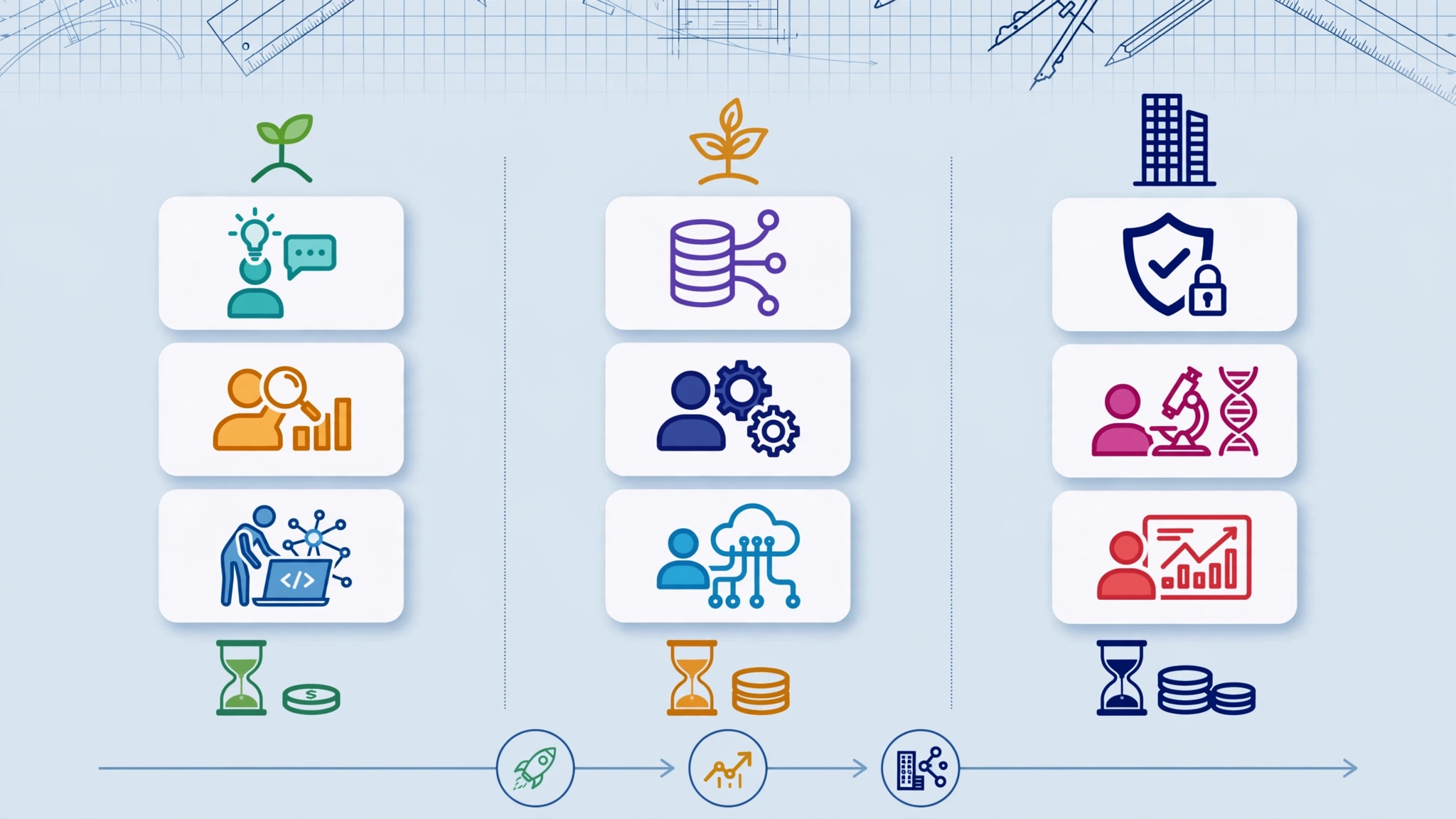
Startup (3–10 People)
Keep it flat and lean. You need:
- One senior ML engineer who sets the technical direction
- One data engineer to build the pipelines
- One AI product manager to own the roadmap
At this stage, the ML engineer often does some of what an MLOps engineer would do, and the data engineer handles some data science tasks. That is fine. The goal here is to prove that your AI can solve a real problem, not to run a perfectly optimized organization.
Growing Company (10–50 People)
Functional structure starts to make sense. Roles become more specialized:
- Dedicated data scientists separate from ML engineers
- A full-time MLOps engineer once models are in production
- An AI architect if multiple products are using AI
- An AI ethics officer if you are operating in a regulated space
You are no longer just proving concepts. You are building systems that need to be reliable, maintainable, and defensible. Structure and process matter more here.
Enterprise (50+ People)
A hub-and-spoke model typically works best. A central AI platform team builds shared infrastructure, tools, and reusable components. Embedded AI specialists sit within individual product teams and use those shared resources to build domain-specific applications.
This prevents the worst-case scenario: dozens of teams all building redundant infrastructure independently, with no shared standards and no way to leverage each other’s work.
The Right Hiring Sequence for Building an AI Team
Getting the order right matters more than moving fast. Here is a practical sequencing framework:
Months 1–3:
- Hire an AI Product Manager and a Senior ML Engineer together. The PM defines the problem. The engineer validates feasibility. Without both in place simultaneously, you risk building the right thing the wrong way or the wrong thing expertly.
Months 3–6:
- Add a Data Engineer. You cannot scale without clean, reliable data infrastructure. This hire often unlocks productivity for everyone already on the team.
- Add a mid-level ML engineer to pair with your senior.
Months 6–9:
- Bring on an MLOps Engineer as your first model nears production. Do not wait until it is live. Set up the operational scaffolding in parallel with the final stages of development.
- Add a Data Scientist to deepen your modeling capabilities.
Month 9 and Beyond:
- Scale based on what your production data tells you. If you have multiple models degrading, invest in MLOps. If you have more use cases than data capacity, hire more data engineers. If cross-team coordination is breaking down, bring in an AI architect.
Common Mistakes When Building an AI Team Structure
Knowing what to avoid is as useful as knowing what to do.
Hiring data scientists before the data is ready. This is probably the most common mistake. Data scientists working with messy, inaccessible data produce messy, unreliable models. Build the foundation first.
Expecting one person to do multiple specialized jobs. Asking your ML engineer to also handle MLOps and data engineering is like asking your backend developer to also run DevOps and product. It works temporarily and fails eventually.
Treating AI as purely a technology project. AI initiatives without business ownership stall. Someone needs to be accountable for whether the AI creates value, not just whether it technically works.
Ignoring model maintenance. Deploying a model is not the end of the job. It is the beginning of a new one. Models drift. Data changes. User behavior shifts. Without an MLOps function and clear ownership of monitoring, your models will quietly degrade.
Building in isolation. AI teams that operate as a separate unit with no connection to the broader engineering and product organization end up building things that do not integrate. Embed AI thinking into the wider company rather than siloing it.
In-House vs. Outsourced AI Teams
Not every role needs to be a full-time hire. For many companies, a hybrid approach makes more sense: permanent hires for roles that require deep company context (AI PM, senior ML engineer), and contractors or specialized firms for roles where you need speed or specialized expertise (MLOps setup, bias auditing, architecture review).
Staff augmentation works particularly well in the early stages when you need to move fast and do not yet know which skills you need permanently. It also works for one-time tasks like setting up data infrastructure or doing a compliance audit.
The key question is: does this role require deep institutional knowledge and continuity, or is it a defined deliverable? If the former, hire. If the latter, augment.
Conclusion
Building an AI team structure is not a one-time decision. It is an evolving function that should grow with your AI maturity, starting small with a product manager and a senior ML engineer, building data infrastructure before you scale modeling, bringing MLOps in before your first production deployment, and expanding into specialized roles like AI architect and ethics officer as complexity demands. The companies that get this right treat AI team design with the same rigor they would apply to product strategy: with clear ownership, defined sequencing, and a honest read on where they actually are versus where they want to be.