How Workflow Automation and Managed IT Are Transforming Operations for Boca Raton Businesses
Workflow automation in Boca Raton improves efficiency, reduces errors, and boosts productivity when supported by reliable, secure, and scalable IT infrastructure.
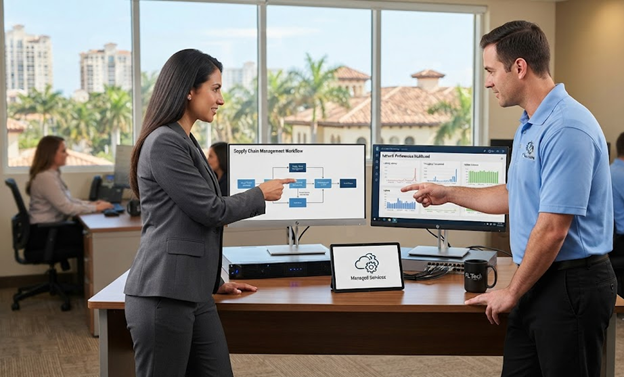
Workflow automation has become one of the highest-priority operational investments for businesses across Boca Raton’s financial services, healthcare, and professional services sectors. The efficiency gains from eliminating manual handoffs, reducing processing time on routine tasks, and creating consistent, auditable process execution are real and measurable. Organizations that have deployed workflow automation across their key operational processes report productivity improvements, error reductions, and staff capacity releases that translate directly into competitive advantage.
What those same organizations consistently discover is that the performance of their automation investments is directly dependent on the quality of the IT infrastructure supporting them. Workflow automation tools are sophisticated enough to handle complex business logic. They are also dependent on the network performance, data integration reliability, system uptime, and security architecture of the environments they operate within. Automation that runs on poorly managed IT infrastructure underperforms relative to its potential, and the efficiency gains that drove the investment are only partially realized.
The organizations achieving the strongest outcomes from workflow automation in Boca Raton are the ones that treated managed IT as the foundational layer their automation investments were built on, not an afterthought addressed after the automation tools were already deployed.
Why Workflow Automation Performance Depends on IT Infrastructure Quality
Workflow automation tools are increasingly capable. Modern automation platforms can handle document processing, multi-step approval workflows, system integrations across dozens of applications, exception routing, and compliance documentation with sophistication that was not available to mid-market businesses a few years ago. The technology is not the constraint.
The constraint, in most cases, is the infrastructure the automation runs on. And infrastructure quality is directly determined by whether that infrastructure is being managed proactively or reactively.
Network performance is the most visible IT infrastructure variable affecting automation outcomes. Workflow automation that coordinates actions across cloud platforms, on-premises systems, and third-party APIs is sensitive to the latency and reliability of the network connections those integrations depend on. An automation process that routes documents between five systems and generates a report in three seconds on a well-managed, appropriately provisioned network may take forty seconds on a network with congestion, suboptimal routing, or bandwidth constraints that have accumulated without proactive management. Forty-second cycles on high-volume processes eliminate much of the efficiency gain that the automation was supposed to deliver.
System availability is the infrastructure variable that creates the most visible automation failures. An automation workflow that depends on a specific system being available is only as reliable as the availability of that system. When systems experience unplanned downtime, automation workflows that depend on them stop or fail. The backlog that accumulates during a system outage can take hours to clear after the system is restored, and the manual intervention required to manage that backlog consumes the staff capacity that automation was supposed to free.
Managed IT services that monitor system health proactively, identify availability threats before they become outages, and maintain the update and patch discipline that prevents software-related availability events are directly protecting the reliability of the automation workflows built on those systems.
Integration reliability is the infrastructure variable that creates the most persistent automation underperformance. Enterprise automation workflows depend on API connections, database integrations, and file exchange processes between systems that each carry their own reliability characteristics. When those integrations drift, when API credentials expire, when schema changes in one system break the integration with another, or when data quality in source systems degrades, automation workflows produce errors, route exceptions to manual queues, and lose the efficiency gains that drove their development.


Managed IT services that monitor integration health, catch configuration drift before it creates errors, and maintain the documentation of integration dependencies that makes troubleshooting efficient are directly maintaining the integration reliability that automation ROI depends on.
The Automation Use Cases Producing the Most Impact in Boca Raton
The specific workflow automation deployments producing the most measurable efficiency gains for Boca Raton businesses reflect the industries and operational patterns that define the local business community.
Financial Document Processing
Wealth management and financial advisory firms in Boca Raton handle significant volumes of document-intensive processes: client onboarding documentation, account application processing, compliance reporting, and the trade confirmation and statement generation workflows that run continuously across the business. Automating these workflows with intelligent document processing and structured routing significantly reduces the staff hours consumed by manual document handling while improving accuracy and creating the complete audit trail that regulatory compliance requires.
The IT infrastructure requirements for these automation workflows include the secure cloud connectivity that financial document platforms require, the identity and access management that controls who can initiate and approve each step in the workflow, and the security monitoring that ensures sensitive client financial documents are handled in compliance with the SEC requirements and FINRA examination expectations applicable to the firm.
Healthcare Administrative Workflows
Healthcare practices in Boca Raton are deploying workflow automation across the administrative processes that consume clinical and administrative staff time without contributing directly to patient care: scheduling coordination, insurance verification, prior authorization tracking, billing workflow management, and the compliance documentation workflows that HIPAA requires.
The IT infrastructure supporting healthcare workflow automation must satisfy HIPAA’s technical safeguard requirements for any workflow involving protected health information. The managed IT foundation that maintains the security controls, access logging, and system availability required for HIPAA compliance is the same foundation that healthcare automation workflows depend on to perform reliably.
Professional Services Process Management
Law firms, accounting practices, and consulting organizations in Boca Raton are automating the administrative dimensions of their professional workflows: matter intake and conflict checking, document assembly and version control, billing and time tracking workflows, and the compliance documentation processes that regulated professional services require.
For professional services firms, the IT infrastructure requirements for workflow automation center on the document management and collaboration platforms that these workflows coordinate, the identity management that controls access to confidential client work product, and the availability and performance of the systems that professional staff depend on for client delivery.
The Security Architecture That Makes Automation Safe
Workflow automation deployments that handle sensitive business data, regulated personal information, or confidential client materials require security architecture that protects that data throughout the automated process, not just at the endpoints where human staff interact with it.
Data that moves through an automated workflow passes through multiple systems, may be stored temporarily in process queues, and is transmitted across network connections between platforms. Each of these points in the data flow is a potential exposure point if the security architecture is not specifically designed to protect data in automated processes.
Access controls for automated workflows must be designed around the principle of least privilege: each automated process should have access only to the specific data and system functions it requires to execute its defined tasks. Overly broad access permissions granted to automation service accounts create the same exposure as overly broad permissions granted to human users, and the potential impact is amplified because automation workflows can act on many data records in a short period.
Audit logging for automated processes must capture the actions taken, the data accessed, the decisions made at each routing point, and the outcomes produced with the same completeness that regulatory frameworks expect from human-executed processes. For Boca Raton businesses subject to SEC, HIPAA, or PCI-DSS requirements, the audit trail that workflow automation produces is part of the compliance documentation that examinations and audits evaluate.
Managed IT services that maintain the security architecture required for compliant automation deployment and continuously monitor that architecture against the applicable compliance frameworks are directly supporting the regulatory standing of the automation programs they enable.
Connecting Automation Strategy to Managed IT Planning
The businesses achieving the strongest automation outcomes in Boca Raton are the ones that have connected their automation roadmap to their managed IT planning rather than treating them as separate initiatives.
When the IT management team understands which automation workflows are planned for the next twelve months, they can ensure that the infrastructure required to support those workflows is in place before deployment begins rather than being identified as a gap during implementation. Network capacity planning that accounts for the additional traffic that automation integrations will generate. Security architecture reviews that ensure new automation workflows will satisfy applicable compliance requirements from day one. System availability planning that prioritizes the uptime of the systems that critical automation workflows depend on.
This connected planning approach produces automation deployments that perform at the level their design intended from the moment they go live, rather than underperforming until the IT infrastructure gaps that were not identified during planning are discovered and addressed.
How Mindcore Technologies Supports Workflow Automation for Boca Raton Businesses
Mindcore Technologies delivers the managed IT infrastructure that makes workflow automation investments perform as intended for Boca Raton businesses across financial services, healthcare, and professional services. With more than 30 years of IT operations and technology strategy experience, Mindcore brings the infrastructure management depth and the regulatory compliance knowledge that automation deployments in Boca Raton’s regulated sectors require.
Under the leadership of Matt Rosenthal, CEO of Mindcore Technologies, the company provides managed IT services in Boca Raton that maintain the network performance, system availability, integration reliability, and security architecture that workflow automation depends on. Their approach treats managed IT as the operational foundation for the automation strategy rather than as a separate function, connecting infrastructure planning to the automation roadmap to ensure that the environment is ready when new automation deployments arrive.
Conclusion
Workflow automation is one of the highest-return operational investments available to Boca Raton’s financial services, healthcare, and professional services businesses. The efficiency gains, compliance documentation improvements, and staff capacity releases that well-implemented automation delivers are real and compounding over time. The degree to which those gains are realized, however, is directly determined by the quality of the managed IT infrastructure the automation runs on.
The businesses in Boca Raton that are achieving the full potential of their automation investments are the ones that connected their automation strategy to a proactively managed IT foundation from the beginning. With Mindcore Technologies and more than 30 years of managed IT and technology strategy expertise, building that foundation is the logical starting point for any automation investment that is intended to deliver on its projected return.
About the Author
Matt Rosenthal is the CEO and President of Mindcore Technologies, a full-service IT consulting and cybersecurity firm serving businesses across Florida, New Jersey, Maryland, South Carolina, Louisiana, Texas, and nationwide.
With more than 30 years of experience in IT operations, managed services, and business technology strategy, Matt has helped organizations across financial services, healthcare, and professional services build the IT foundations that make workflow automation and digital transformation investments perform as intended. He holds an MBA in Technology Management, is a certified Project Management Professional (PMP), and is the host of Digging In, a weekly podcast on success in business, life, and health.